
Career Options After B.Com in 2026: Jobs, Professional Courses and Higher Studies
27
Oct
Career Options After B.Com in 2026: Jobs, Professional Courses and Higher Studies
Published: October 27, 2026
Last Updated: October 27, 2026
Quick Answer: What Are the Best Career Options After B.Com?
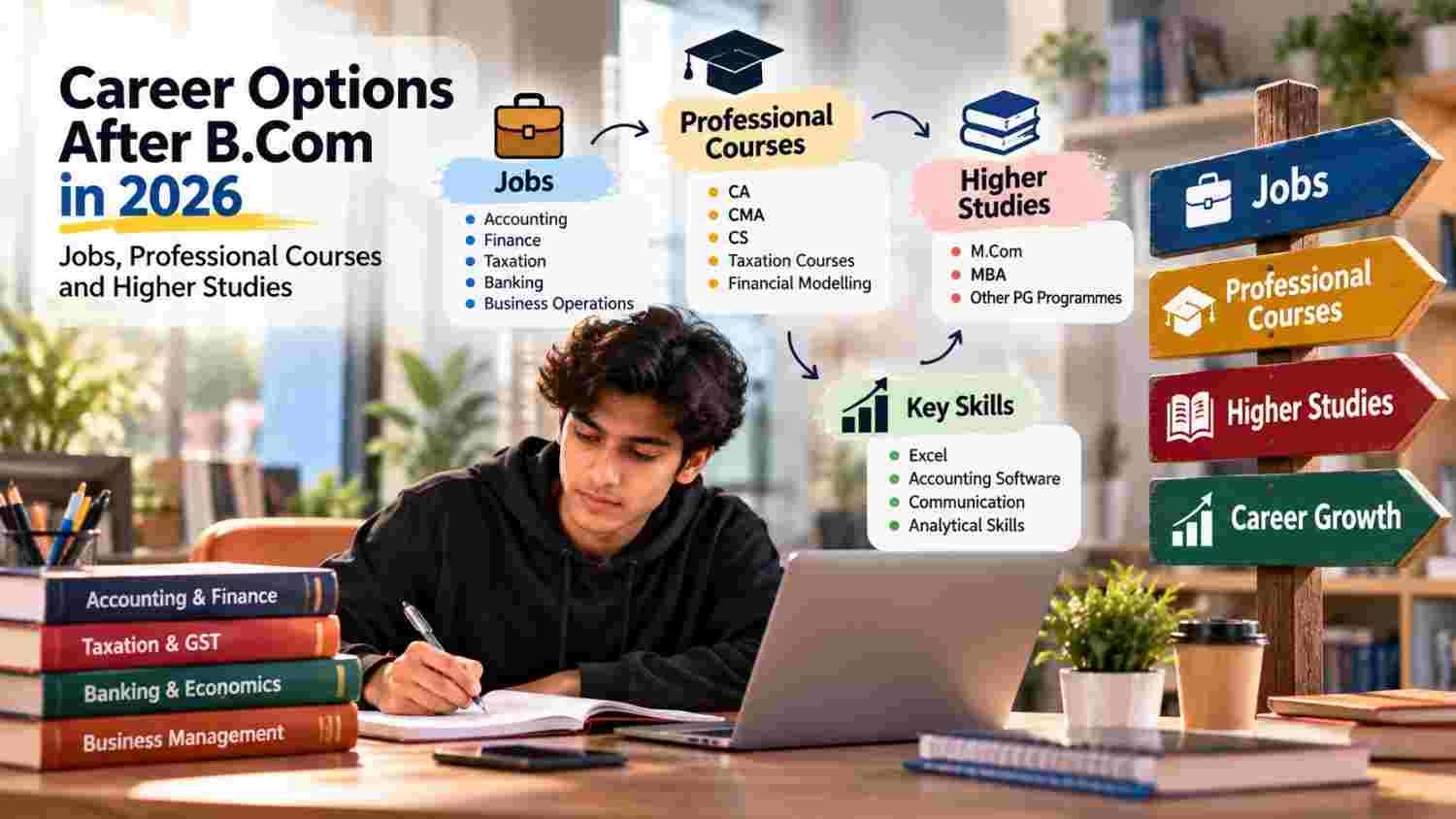
The best career options after B.Com include accounting, finance, taxation, banking, business operations, professional qualifications, and postgraduate studies. Graduates can explore entry-level jobs, pursue qualifications such as CA, CMA or CS, or consider M.Com and MBA programmes. However, the right path depends on your interests, eligibility, financial situation and long-term goals. Building practical skills in spreadsheets, accounting software, communication and financial analysis can also help you prepare for relevant opportunities.
Key Takeaways
Jobs: Explore accounting, finance, taxation, payroll, banking and business operations.
Professional courses: Consider CA, CMA or CS after checking the relevant eligibility requirements.
Higher studies: Compare M.Com, MBA and other postgraduate programmes.
Practical skills: Develop spreadsheet, accounting software, communication, and analytical skills.
Career planning: Choose a path based on your interests instead of following salary claims alone.
Before enrolling: Verify course recognition, eligibility, fees, and examination requirements.
Who Should Read This Guide?
This guide is designed for B.Com students approaching graduation, recent commerce graduates and working professionals who want to improve their qualifications.
It can help if you are:
Unsure what to do after completing B.Com.
Comparing a job with further studies.
Interested in accounting, taxation, or finance.
Considering CA, CMA, CS, M.Com or MBA.
Looking for practical skills to strengthen your employment prospects.
Although these options are relevant to many commerce graduates in India, not every route suits every student. Therefore, use this guide to shortlist possibilities before checking the detailed requirements of each course or employer.
Best Career Options After B.Com in 2026
A Bachelor of Commerce can provide a foundation in accounting, business, finance, and taxation. After graduation, you can use that foundation to explore several career areas.
These are possible career directions, not guaranteed jobs. Employers may require additional qualifications, relevant experience, computer skills or competitive examination results.
Accounting and Finance
Accounting and finance can suit graduates who enjoy working with numbers, financial records and business information.
Depending on the employer, entry-level responsibilities may include maintaining records, preparing reports, checking transactions and assisting with routine financial tasks.
To prepare, practise spreadsheet formulas, basic financial reporting and accounting software. Additionally, consider internships or supervised projects that let you apply these skills to realistic business situations.
Taxation and GST
Tax-related work may appeal to students interested in financial compliance, documentation and tax calculations.
Possible starting roles include tax assistant, accounts assistant or junior tax associate. However, the responsibilities permitted for a particular role depend on applicable rules, professional qualifications and employer requirements.
Learn the fundamentals of income tax, GST documentation and financial records. Furthermore, keep your knowledge current because tax rules and filing requirements can change.
Banking and Financial Services
Commerce graduates may explore banking operations, customer service, financial-service support and relevant recruitment examinations.
The eligibility requirements differ between private employers, public-sector banks and specific recruitment processes. Consequently, check the official notification before preparing for an examination or applying for a position.
Business Operations and Administration
If you prefer coordination and business processes over specialised accounting, operations and administration may be worth considering.
These roles can involve preparing reports, maintaining records, coordinating with teams, managing documentation and supporting day-to-day business activities. Strong communication, organisation and spreadsheet skills are useful starting points.
Best Professional Courses After B.Com
Professional qualifications can help you develop specialised knowledge, but they usually require a sustained commitment to study and examinations.
Short courses and professional qualifications are not equivalent. Before enrolling, understand the credential you will receive, the course provider, the syllabus and its relevance to your intended role.
Chartered Accountancy (CA)
CA is a professional route for students interested in accounting, auditing, taxation and financial reporting.
The Institute of Chartered Accountants of India (ICAI) publishes the official course structure and eligibility requirements. Under its Direct Entry Route, eligible commerce graduates and postgraduates generally need at least 55% marks, while graduates from other streams generally need at least 60%, subject to the applicable rules.
Check the current requirements directly with ICAI before registering: https://www.icai.org/
CA involves professional examinations and other prescribed requirements. Therefore, evaluate the preparation time, costs and commitment before choosing this path.
Cost and Management Accountancy (CMA)
CMA focuses on areas such as costing, management accounting, financial reporting and business decisions.
The Institute of Cost Accountants of India (ICMAI) provides the official course overview and eligibility information. Its rules include a route for graduates to enter the Intermediate level, subject to applicable conditions.
Official eligibility information: https://icmai.in/ClntStudents/CourseEligibility
CMA may be worth exploring if you enjoy understanding how businesses measure costs, manage budgets and use financial information to make decisions.
Company Secretary (CS)
The Company Secretary qualification focuses on company law, corporate governance, compliance and related regulatory responsibilities.
It may suit graduates interested in corporate compliance and governance rather than a career focused entirely on accounting. Review the current course structure, entry requirements and examination stages through the Institute of Company Secretaries of India (ICSI): https://www.icsi.edu/
Higher Studies After B.Com: M.Com or MBA?
Postgraduate study is another option if you want to develop deeper subject knowledge or prepare for a different professional direction.
Neither degree guarantees a particular job or salary. The outcome depends on the institution, your skills, work experience, chosen specialisation and employer requirements.
When Should You Choose M.Com?
M.Com may be appropriate if you want to continue studying commerce, accounting, taxation or finance in greater depth.
It can also be relevant for learners considering research or teaching-related pathways. However, specific teaching positions and further academic opportunities may require additional qualifications or eligibility tests.
When Should You Choose MBA?
An MBA may be worth considering if you want to study management, marketing, human resources, finance, operations or business strategy.
Before selecting an MBA programme, compare its curriculum, total cost, admission process, practical projects and available career support. Do not rely only on advertised placement packages or general salary claims.
Which Skills Should You Learn After B.Com?
A degree provides academic knowledge, while practical skills can help you demonstrate how you apply that knowledge.
Consider developing the following:
Excel or spreadsheet skills: Practise formulas, sorting, filtering, charts and financial calculations.
Accounting software: Learn the tools relevant to the roles you want to pursue.
Financial reporting: Understand how to organise and interpret business figures.
Tax documentation: Learn basic compliance concepts and the importance of accurate records.
Communication: Practise writing professional emails and explaining information clearly.
Analytical thinking: Work through business examples and explain your conclusions.
Digital skills: Become comfortable with online research, document management and collaborative tools.
You do not need to master everything at once. Instead, choose two or three skills that match your preferred career area and practise them consistently.
How to Choose the Right Career Options After B.Com
Use this simple process to compare your options.
Step 1: Identify your interests. Decide whether you prefer accounting, taxation, finance, management, compliance or business operations.
Step 2: Check your eligibility. Review academic requirements, entrance examinations and professional course rules.
Step 3: Compare the time and cost. Include tuition, registration, examination fees, study materials and the time needed to prepare.
Step 4: Assess your current skills. Identify gaps in spreadsheets, accounting software, communication or subject knowledge.
Step 5: Explore real opportunities. Read job descriptions and official recruitment notices to understand what employers actually require.
Step 6: Make a realistic plan. Choose a primary route and a practical backup. Review your progress after gaining experience or completing relevant training.
For example, a graduate interested in accounting might first strengthen spreadsheet skills and apply for relevant entry-level roles while exploring professional qualifications. In contrast, someone interested in management may compare MBA programmes and their admission requirements.
Career Options After B.Com: Job or Further Studies?
The decision depends on your immediate needs and longer-term goals.
You do not have to choose the same route as your friends. First, understand your interests, financial circumstances and responsibilities. Then compare the realistic time and effort each option requires.
Common Mistakes to Avoid After B.Com
A rushed decision can cost time and money. Keep these points in mind:
Choosing a course only because it is popular: Check whether its subjects and career paths fit your interests.
Believing guaranteed salary claims: Treat salaries as variable and check role-specific requirements.
Ignoring practical skills: Combine academic study with relevant practice.
Overlooking eligibility: Verify official rules before paying registration or admission fees.
Joining without comparing costs: Review the complete fee structure, not just the advertised starting fee.
Preparing for too many routes simultaneously: Set priorities and create a manageable schedule.
For professional qualifications and postgraduate programmes, always refer to the relevant institute or university for the latest requirements.
Career Planning After B.Com: A Practical Example
Imagine a B.Com graduate who enjoys accounting but is uncertain about committing to a long professional qualification.
A reasonable starting plan could be:
Review job descriptions for junior accounting and accounts-assistant roles.
Practise spreadsheet-based bookkeeping and financial reporting.
Apply for relevant internships or entry-level positions.
Compare CA, CMA and other qualifications using official eligibility and course information.
Decide whether to work, study, or combine both based on available time and resources.
This example is a planning approach, not a promise of employment. The purpose is to turn a broad decision into smaller steps that can be evaluated.
How Tulyarth EduTech Can Help You Explore Your Next Step
Choosing what to do after graduation can be confusing when several courses and career paths appear suitable. Start by identifying your goals, then compare programmes based on curriculum, eligibility, duration, fees, and learning format.
You can learn more about the platform on the About Us page. For questions about available programmes or education guidance, visit the Contact Us page.
Confirm the latest course details and admission requirements with the relevant university or professional institute before making a decision.
Conclusion
The best career options after B.Com depend on what you want to do next. Accounting, finance, taxation, banking and business operations can offer different starting points, while CA, CMA, CS, M.Com and MBA provide routes for further specialisation.
However, the most suitable path is not necessarily the longest course or the one with the biggest salary claim. Compare eligibility, costs, learning requirements, and actual job descriptions. Build practical skills alongside your studies, and choose a plan that fits your interests and circumstances.
A clear next step is more useful than deciding your entire career at once. Start with one or two relevant options, verify the facts and make an informed decision.
When comparing career options after B.Com, consider your interests, budget, eligibility, and the practical skills your preferred role requires.
Latest Blogs
You may also find these articles helpful:
Online vs Distance Education in 2026: Differences, Fees and How to Choose
Best Courses After 12th for Students Who Want to Start Earning Early in 2026
How to Balance College Studies and Internship in 2026: A Practical Guide
M.Com Course in Dehradun: Eligibility, Fees, Duration & Career Scope in 2026
LLB Course in Dehradun: Eligibility, Fees, Duration & Career Scope in 2026
Frequently Asked Questions
Common options include accounting, finance, taxation, auditing, banking, payroll and business operations. Graduates can also explore professional qualifications or postgraduate study, depending on their interests and eligibility.
There is no single best course for everyone. CA may suit students interested in accounting and auditing, CMA those interested in costing and management accounting, and CS those interested in corporate law and compliance.
Yes, some employers advertise entry-level positions suitable for fresh graduates. Requirements vary, so review job descriptions and develop relevant practical skills to strengthen your applications.
M.Com generally focuses more on commerce-related subjects, while MBA programmes focus on management and business functions. Compare the curriculum, eligibility, fees and your long-term goals before choosing.
Useful skills may include spreadsheets, accounting software, financial reporting, communication, analytical thinking and basic tax documentation. Prioritise those that match the jobs or qualifications you intend to pursue.