Best Courses After 12th for Students Who Want to Start Earning Early in 2026
15
Oct
Best Courses After 12th for Students Who Want to Start Earning Early in 2026
Published: October 15, 2026
Last Updated: October 15, 2026
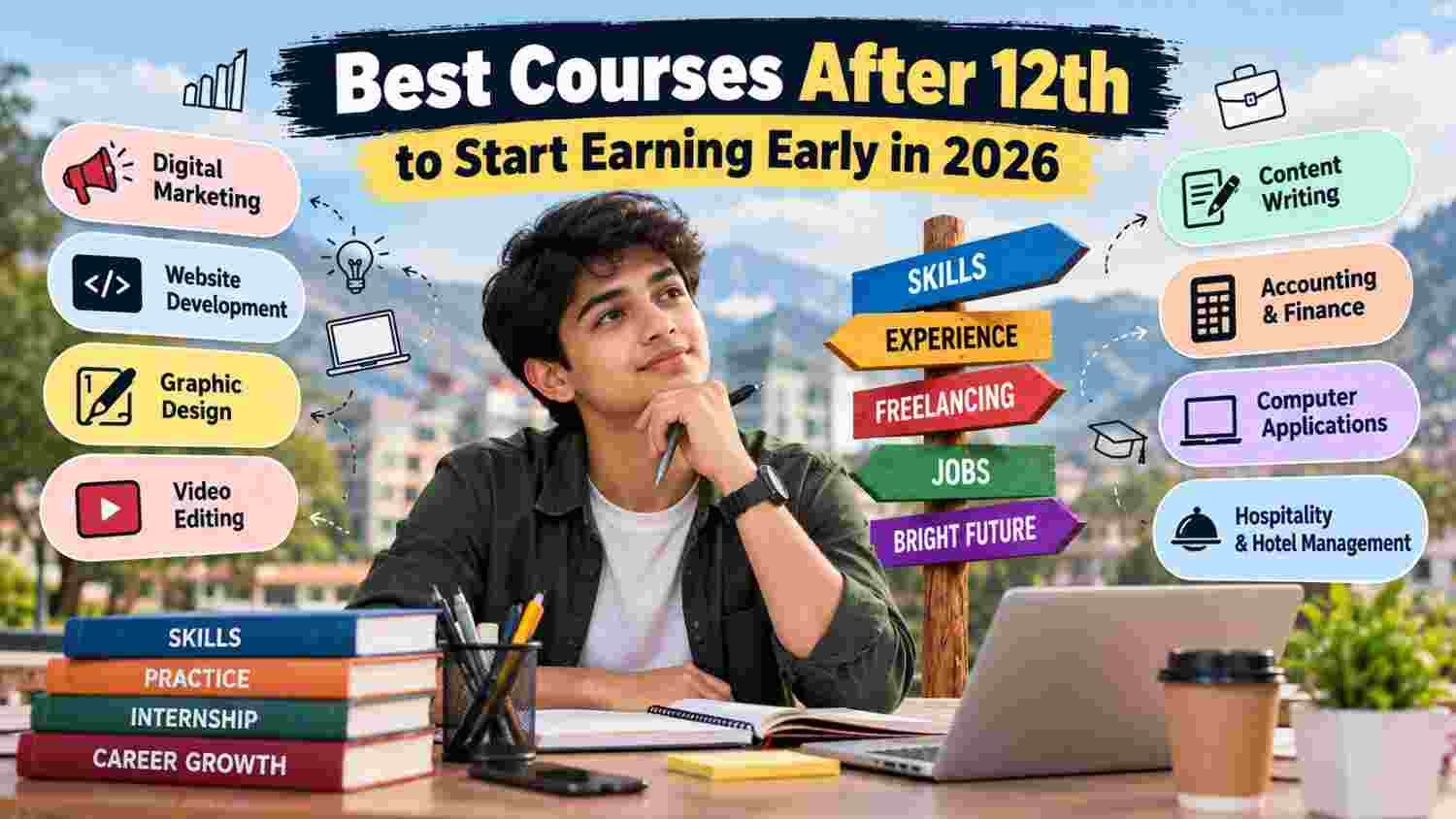
The best courses after 12th to start earning can help students develop practical skills for jobs, internships, and freelance projects. Popular options include digital marketing, website development, graphic design, video editing, content writing and accounting. The right course depends on your interests, budget and career goals. Practical training and project work can help you prepare for employment, although no course guarantees a job.
Quick Answer: Which Course Is Best After 12th to Start Earning?
Digital marketing and website development may suit students interested in technology and online business. Graphic design and video editing are options for creative students, while accounting and computer applications can help prepare you for certain office roles. Hospitality is worth considering if you enjoy customer service.
Before enrolling, compare the syllabus, practical projects, total fees, and career support. Choose a course that teaches useful skills rather than relying only on a certificate or placement promise.
Key Takeaways
Choose a course according to your interests and career goals.
Practical skills can help you prepare for entry-level opportunities.
Short-term training can be useful when it includes real projects.
Check job requirements before investing in a course.
A certificate alone does not guarantee employment or a particular salary.
Who Should Choose These Courses After 12th?
This guide is designed for students who have completed Class 12 in Science, Commerce or Arts and want to explore career-oriented training in 2026. It is especially useful if you want to prepare for an entry-level job, apply for an internship, start freelancing or develop practical skills alongside your college degree.
Students interested in technology can compare website development courses, while those who enjoy creativity can explore graphic design, video editing and content writing. Commerce students interested in business operations may consider accounting or digital marketing. Students who prefer customer-facing work can explore hospitality training.
Use this guide before selecting a course or paying an institute's fees. Compare the skills taught, course duration, practical assignments, total cost and qualifications required for relevant jobs. Your final choice should match your interests, educational background, budget and the career opportunities available in your preferred location.
Parents and career counsellors can also use this comparison to help students evaluate training options. Remember that course completion does not guarantee employment, a specific salary or immediate earnings.
Why Consider Job-Oriented Courses After 12th?
After Class 12, you may want to gain work experience, become financially independent or explore a career before committing to a longer qualification. Job-oriented courses after 12th can help you learn skills for specific types of work.
For example, digital marketing teaches you how businesses promote products online. Website development teaches you how to build websites, while accounting courses focus on financial records and office tasks.
According to India's Periodic Labour Force Survey Annual Report 2025, the unemployment rate among educated people aged 15 and above was 6.5% in 2025, compared with 7.0% in 2024, using the report's usual-status measure. This is a broad employment statistic, not a prediction of job prospects for any individual course. It is still important to develop relevant skills and research the roles you want to pursue.
Source: Official PLFS 2025 report.
Best Courses After 12th to Start Earning in 2026
1. Digital Marketing Course
Digital marketing helps businesses reach customers through search engines, social media, websites, and online advertising.
Skills you can learn:
Search engine optimisation (SEO)
Social media marketing
Keyword research
Content planning
Google Ads basics
Website analytics
Career options: SEO trainee, digital marketing intern, social media executive, or junior marketing assistant.
How to practise: Create a sample content calendar, conduct a basic website SEO audit or prepare a keyword research report. These projects can help demonstrate your skills when applying for internships or entry-level roles.
2. Website Development Course
Website development is suitable for students who enjoy computers, technology and problem-solving.
Skills you can learn:
HTML and CSS
JavaScript basics
Responsive website design
Website testing
WordPress or another content management system
Basic debugging
Career options: Web development intern, junior website developer or website maintenance assistant.
How to practise: Build a portfolio website and a sample website for a local business. Test the pages on mobile and desktop devices before adding them to your portfolio.
3. Graphic Design Course
Graphic design focuses on communicating ideas through images, layouts, typography and colour.
Skills you can learn:
Social media post design
Poster and banner design
Image editing
Typography and layout
Branding fundamentals
Design software
Career options: Junior graphic designer, design assistant or social media designer.
How to practise: Create original posters, promotional creatives and social media designs. Include a variety of samples to show your design ability.
4. Video Editing Course
Video editing may suit students who enjoy storytelling and digital content. Businesses and creators use videos for marketing, education and communication.
Skills you can learn:
Cutting and arranging clips
Audio adjustment
Captions and subtitles
Basic colour correction
Short-form video editing
Export settings
Career options: Editing assistant, junior video editor or freelance video editor.
How to practise: Create a few short videos with clear captions, balanced audio and suitable pacing. Use practice footage or material you have permission to edit.
5. Content Writing and SEO Writing Course
Content writing is an option for students who enjoy reading, researching and explaining information.
Skills you can learn:
Blog and article writing
Research and fact-checking
Grammar and editing
Keyword research
SEO-friendly headings
Internal linking
Career options: Content writing intern, junior copywriter or SEO content assistant.
How to practise: Write two or three original articles on topics you understand. Use reliable sources and check every important fact before publishing.
6. Accounting and Spreadsheet Course
Students who prefer numbers and organised office work can explore accounting and spreadsheet training.
Skills you can learn:
Basic accounting
Billing and invoices
Spreadsheet formulas
Data organisation
Accounting software basics
Simple financial reports
Career options: Accounts assistant, billing assistant or office support trainee, depending on your qualifications.
How to practise: Prepare sample invoices and expense sheets using fictional data. Learn to check totals and correct mistakes.
7. Computer Applications Course
Computer applications training can help you develop everyday workplace skills.
Skills you can learn:
Word processing
Spreadsheets
Presentations
Email communication
File management
Online research
Career options: Office assistant, administrative trainee or documentation assistant, depending on employer requirements.
How to practise: Create a formatted document, a spreadsheet and a presentation. You can also improve typing accuracy and professional email writing.
8. Hospitality and Hotel Management Course
Hospitality may suit students who enjoy customer interaction, teamwork and service-related work.
Skills you can learn:
Guest relations
Front office operations
Food and beverage service
Housekeeping basics
Professional communication
Customer service
Career options: Hospitality trainee, front office assistant or guest service trainee.
For a formal qualification, explore the NCHMCT B.Sc. in Hospitality and Hotel Administration. Check the latest official admission notice for eligibility, fees and course details before applying.
9. Photography and Digital Media Course
Photography and digital media can suit students who enjoy visual storytelling and creative projects.
Skills you can learn:
Composition and lighting
Camera or mobile photography
Image editing
Product photography
Basic content production
File management
Career options: Photography assistant, junior media assistant or content production trainee.
How to practise: Create a portfolio featuring products, objects or staged scenes. Focus on lighting, composition and consistent editing.
When comparing the best courses after 12th to start earning, consider the practical skills taught, course fees, training quality, and job opportunities available in your preferred field.
Comparison Table: Job-Oriented Courses After 12th
The learning periods below are estimates for introductory training, not guarantees of job readiness. Actual duration depends on the course and your practice.
How to Choose the Best Courses After 12th to Start Earning in 2026
Choose According to Your Interests
Your interests can help you narrow down the options.
Enjoy technology? Explore website development.
Like online platforms and business promotion? Consider digital marketing.
Prefer creative work? Try graphic design or video editing.
Enjoy writing? Explore content writing.
Like numbers? Consider accounting and spreadsheets.
Enjoy meeting people? Explore hospitality.
Try a beginner lesson or small project before paying for a course.
Check the Syllabus and Practical Training
Ask for the full syllabus. Check whether the course includes assignments, trainer feedback and projects using relevant tools. A course that teaches only theory may not prepare you adequately for workplace tasks.
Compare Fees and Career Support
Ask about the total cost, including registration, examinations, software and certificates. If an institute advertises placement support, clarify whether it offers interview preparation, internship assistance or confirmed employment. Verify its claims independently.
Check Job Requirements
Read job descriptions for the roles you want. Some employers accept candidates with relevant skills and practical projects, while others require a degree or specific qualification. Do not assume that a short-term course replaces every formal education requirement.
Short-Term Courses After 12th for Quick Employment
Short-term courses after 12th can help you learn a focused skill, but a short duration does not guarantee quick employment.
Your progress depends on the quality of training, your practice, the available jobs and employer requirements. Build sample projects while learning and begin applying for suitable internships when your skills are ready.
For example, a beginner designer can prepare original creative samples. A student learning website development can build a small website. Someone learning accounting can practise spreadsheets and invoices using fictional information.
Focus on becoming capable of performing the work rather than completing a course as quickly as possible.
How to Start Earning While Learning
Follow these five steps to prepare for your first opportunity.
Step 1: Select one skill. Choose one main area instead of trying to master several unrelated subjects simultaneously.
Step 2: Practise regularly. Apply what you learn through small assignments and practical projects.
Step 3: Build a portfolio. Collect your best work and explain what each project demonstrates. Clearly label practice projects.
Step 4: Prepare your resume. Include your education, relevant skills, tools and projects. Do not invent work experience or results.
Step 5: Apply for suitable opportunities. Search company career pages and trusted job portals. India's National Career Service provides job listings, career information and related services. Its jobseeker services are free, so be cautious about anyone demanding unofficial payments for job placement.
A Simple 30-Day Starting Plan
This is a starting plan, not a promise that you will get a job or begin earning within 30 days. Technical skills and formal qualifications may require more time.
Common Mistakes to Avoid
Choosing only because a course is popular: Research the daily work and check whether it matches your interests.
Believing every salary promise: Pay varies by role, employer, location and experience. Do not make financial plans around an advertised salary.
Ignoring practical work: A certificate is not a substitute for the ability to perform tasks. Check for assignments and feedback.
Learning too many skills together: Build a foundation in one main skill before adding related skills.
Paying without verification: Check the institute, syllabus, refund policy and placement terms before enrolling.
How to Explore Career Options After 12th
If you are unsure which field to choose, list your interests and identify jobs connected to them. Compare their educational requirements, everyday responsibilities and learning costs.
You can also explore the Government of India's NCERT My Career Advisor to research career paths and job roles.
If you are looking for training in Dehradun, compare local and online options. Ask about practical classes, course schedules, fees and career support before making a decision.
You may also continue your degree while learning an additional skill. The right combination depends on your career goal and the qualifications expected in your chosen field.
Conclusion
The best courses after 12th to start earning are those that help you develop practical skills for a realistic career goal. Digital marketing, website development, graphic design, video editing, content writing, accounting and hospitality offer different paths to explore.
Compare the syllabus, costs, and job requirements before enrolling. Then practise consistently, build a portfolio and apply for suitable opportunities. Your progress will depend on your skills, preparation and the opportunities available.
To learn more about the organisation, visit Tulyarth EduTech's About Us page. For questions about courses and training details, use the Contact Us page.
Latest Blogs
You may also find these articles helpful:
How to Balance College Studies and Internship in 2026: A Practical Guide
M.Com Course in Dehradun: Eligibility, Fees, Duration & Career Scope in 2026
LLB Course in Dehradun: Eligibility, Fees, Duration & Career Scope in 2026
B.Com Course in Dehradun: Eligibility, Fees, Duration & Career Scope in 2026
BCA Course in Dehradun: Eligibility, Fees, Duration & Career Scope in 2026
Frequently Asked Questions
There is no single best course for everyone. Digital marketing, website development, graphic design, video editing, accounting and hospitality are options to compare. Choose according to your interests and the jobs you want to pursue.
Digital marketing, graphic design, video editing, content writing, accounting and computer applications are possible options. Their usefulness depends on the syllabus, your practical ability, and employer requirements.
Some entry-level jobs and freelance projects may be available without a completed degree, but requirements differ. Check actual job listings before deciding whether you need a degree, a skill course or both.
Digital marketing, website development, graphic design, video editing and content writing can lead to online work opportunities. However, remote jobs and freelance projects are competitive, and you need practical skills and reliable communication.
Check the syllabus, trainer experience, practical assignments, total cost, student feedback, and placement terms. Verify claims independently and avoid enrolling solely because of a guaranteed job or high-salary advertisement.