MCA or MBA After BCA: Which Course Is Better for Your Career in 2026?
08
Aug
MCA or MBA After BCA: Which Course Is Better for Your Career in 2026?
Introduction
If you have completed your BCA and are thinking about higher studies, you may already be facing one common question: MCA or MBA after BCA, which course is better?
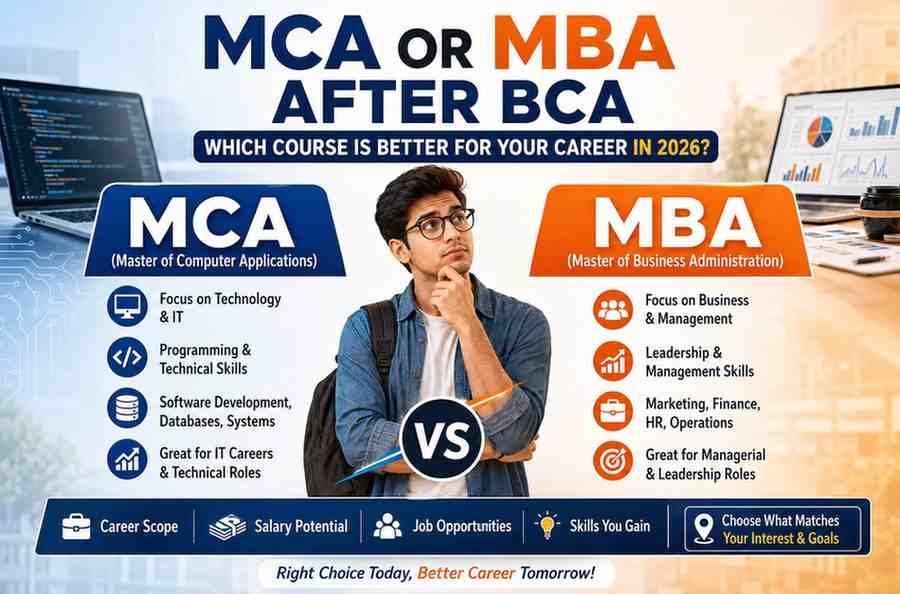
Both options can lead to good career opportunities, but they take you in different directions. MCA is more closely connected with technology, computer applications, software, and IT. MBA focuses more on business, management, marketing, finance, and leadership.
This is why choosing between the two should not be based only on salary or what your friends are doing. Your interests, skills, and career plans matter too.
For example, a BCA graduate who enjoys programming may find MCA more suitable. On the other hand, someone who likes communication, business decisions, and working with people may prefer an MBA.
This article explains the difference between MCA and MBA after BCA, including career scope, salary, jobs, skills and future opportunities, so you can make a more informed decision.
AI Overview
Quick Answer
MCA or MBA after BCA depends on your career goal. Choose MCA if you want to continue towards technical and IT careers. Choose MBA if you want to move towards business, management, or leadership roles.
MCA can help you build deeper technical knowledge, while MBA can help you develop business and management skills. Neither course is automatically better for every BCA graduate.
Summary
MCA is generally a better fit for students who enjoy technology, programming and computer-related work. MBA can be a better fit for students interested in management, marketing, finance, business analysis and leadership.
Before taking admission, compare the course structure, career opportunities, fees, practical exposure and skills required for the jobs you want.
MCA or MBA After BCA: What Is the Main Difference?
The biggest difference between MCA and MBA is the direction they take your career.
MCA continues the technical side of your BCA education. During the course, you can develop your understanding of computer applications, programming, databases, and other areas connected with information technology.
MBA takes you towards the business side. Instead of focusing mainly on technology, you learn about areas such as marketing, finance, human resources, operations, and business management.
So, the question is not simply MCA or MBA which is better. A better question is, "Which type of career do I want?"
If you enjoy working with technology and solving technical problems, MCA may feel more natural. If you enjoy communicating, analysing business problems, and taking decisions, MBA may suit you better.
MCA After BCA: Career Scope and Opportunities
For students who want to remain connected with technology, MCA after BCA can be a logical next step.
Your BCA already gives you an introduction to computers and applications. MCA can help you build on that foundation and develop more advanced knowledge.
After completing MCA, you can explore roles related to software development, application development, databases, system analysis, and other IT functions.
However, your degree is only one part of your profile. Employers also look at practical skills, projects, internships, and your ability to work with current technologies.
The MCA career scope can therefore be stronger when you combine your academic knowledge with practical experience.
Some common career directions include:
Software Development
Application Development
System Analysis
Database Management
IT Support
Data and Technology Roles
The exact opportunities will depend on your skills, experience, location, and the organisation you apply to.
MBA After BCA: Career Scope and Opportunities
An MBA after BCA takes your career in a different direction.
Your technical background does not become useless. In fact, it can be useful in roles where companies need people who understand both technology and business.
For instance, a BCA graduate with an MBA may explore business analysis, product management, digital marketing, operations, or technology-focused management roles.
The MBA career scope is broad because management skills can be used across many industries. Your choice of MBA specialisation can also influence the type of roles you target after graduation.
Marketing, finance, human resources, business analytics and operations are some areas students commonly consider.
However, just like MCA, an MBA does not guarantee a particular salary or job. Your college, specialisation, communication skills, internships and practical knowledge can all influence your career growth.
MCA vs MBA: Which One Matches Your Strengths?
Before choosing a course, think about the work you would actually enjoy doing every day.
If you like coding, software, technology, and technical problem-solving, MCA may be closer to your interests.
If you enjoy communication, planning, business discussions, and working with teams, MBA may be more suitable.
That simple difference can help you narrow down the choice without getting distracted by salary figures or other people's opinions.
MCA vs MBA Salary: Which One Offers Better Earnings?
Salary is one of the first things students consider after completing BCA. However, there is no fixed answer to whether MCA or MBA offers a higher salary.
Your MCA salary in India can depend on your technical skills, job role, experience, company, and location. Similarly, MBA salary in India can vary according to your specialisation, college, experience, and the industry you enter.
For example, an MCA graduate with strong software development skills may earn more than an MBA graduate in an entry-level management role. At the same time, an MBA graduate who moves into a strong business or management position can see significant salary growth with experience.
Therefore, do not choose a course only because someone claims it offers a higher package.
MCA vs MBA Career Opportunities
Both courses can provide different types of career opportunities.
This comparison shows why there is no universal winner. Your preferred career direction should be the starting point.
Which Course Is Better for Long-Term Career Growth?
Long-term growth depends less on the name of your degree and more on what you do with it.
An MCA graduate can continue learning new technologies and move from entry-level technical roles into senior development, architecture, data or other specialist positions.
Similarly, an MBA graduate can build experience and move towards managerial, strategic or leadership positions.
Your career can also change over time. A person who starts in a technical role may later move into management. Likewise, someone with an MBA may work closely with technology teams and develop technical knowledge along the way.
So, when comparing MCA vs MBA career scope, think about where you want to be several years from now rather than focusing only on your first job.
Best Course After BCA: MCA or MBA?
If you are still confused about the Best course after BCA, start with your interests.
MCA can be a stronger choice if you want to:
Build a career in IT
Continue developing technical skills
Work with software and applications
Learn programming and databases
Explore technology-focused roles
MBA may be more suitable if you want to:
Move towards management
Work in marketing or finance
Develop leadership skills
Explore business analysis
Work in operations or corporate roles
Neither choice is automatically better. The right decision is the one that matches your abilities and the kind of work you want to pursue.
Expert Tip for BCA Graduates
Do not select MCA or MBA just because a friend, relative, or social media creator recommends it.
Before applying, look at the actual curriculum and career opportunities. Check what skills employers expect for the roles you are interested in. Also compare fees, internships, placement support, and practical exposure.
If you are considering Best Job Oriented Courses or Skill Development Courses in Dehradun, these factors can help you compare different options more realistically.
A Simple Decision for BCA Students
Still unsure?
Ask yourself one question.
Do you want your next degree to take you deeper into technology or closer to business and management?
If you want deeper technical knowledge, MCA is the more direct path.
If you want to build business and management skills, MBA can be the better direction.
There is no need to choose a course simply because it is considered more popular. Your interest and career plan should have the final say.
What Should You Do Before Taking Admission?
Before making your decision, spend some time researching the course and the institution.
Look at the curriculum, faculty, practical learning opportunities, and placement information. Also understand the admission requirements and total cost of the programme.
If you are comparing Best Job Oriented Courses After 12th, High paying Courses in Dehradun or other professional programmes, make sure the course actually matches your current education and future career plans.
For students who need help understanding different university and course options, professional College Admission Guidance in Dehradun can also make the decision easier.
Final Thoughts
So, MCA or MBA after BCA?
There is no single answer that works for every student.
Choose MCA if you see yourself building a career around technology, software, applications, and technical problem-solving. Choose MBA if you are more interested in business, management, communication, and leadership.
Your BCA degree gives you a foundation. Your next course should help you build the kind of career you actually want.
Before taking admission, compare the course, specialisation, career opportunities, fees, and practical exposure. Most importantly, choose based on your own strengths rather than someone else's career path.
If you are still comparing your options, learn more about Tulyarth EduTech through our About Us page. If you need help with course selection, university options, or admission guidance, you can also reach our team through Contact Us.
Key Takeaways
MCA is more focused on technology and computer applications.
MBA is more focused on business and management.
MCA can suit students who enjoy programming and technical work.
MBA can suit students interested in management and business roles.
Salary depends on skills, experience, role, organisation, and location.
The best course after BCA depends on your individual career goal.
Related Blogs
You may also find these articles helpful:
Is MBA Worth It in 2026? Career Scope, Salary, Jobs & ROI Explained
BCA vs B.Tech: Which Course Is Better for Your Career in 2026?
Best Job-Oriented Courses After 12thDigital Marketing Course vs AI Digital Marketing: Which Should You Learn? (2026)
Best Courses to Get a High-Paying Job in Dehradun
Frequently Asked Questions
MCA can be better for students who want technical and IT careers. MBA may be more suitable for students interested in business and management. Your career goal should determine the choice.
Yes. BCA graduates can pursue an MBA if they meet the admission requirements of the institution they choose.
Yes. MCA can be a suitable choice if you want to continue developing your technical knowledge and build a career in the IT sector.
Neither course guarantees a higher salary. Earnings depend on your role, skills, experience, specialisation, employer, and location.
MCA and MBA are both possible options. MCA is generally more suitable for technical careers, while MBA is more suitable for management and business-oriented careers.