
BCA vs B.Tech: Which Course Is Better for Your Career in 2026?
04
Aug
BCA vs B.Tech: Which Course Is Better for Your Career in 2026?
Choosing between BCA vs B.Tech is one of the most difficult decisions students need to make after completing Class 12. Each of these courses can provide exciting career opportunities in the technology sector. However, they are specifically designed for students who wish to pursue different career paths. Therefore, if you are considering building a career in software, IT, cyber security, artificial intelligence, or cloud computing, it is essential to understand the subtle differences between these courses.
The bottom line is – if you want to become a good programmer, work in the IT field, and pursue a flexible career, then BCA can be a great option. However, if your aim is to learn more about engineering, broader technical expertise, and computer science, B. Tech would be a more suitable choice. Ultimately, the decision depends on your interests and inclinations towards a particular field of study.
Quick Answer
If you are comparing BCA vs B.Tech, then none of them are better, but both are different courses for different career paths. BCA is for people who want to learn more about software development and information technology through application-based studies, and B.Tech is for people who want to learn about engineering, research, and core computer science concepts. So, choose the course that you like, instead of comparing them and getting confused about which is better.
Key Takeaway
Both BCA and B.Tech have scope for having a good career in the IT sector. However, apart from the courses, it is your technical skills, knowledge, experience, internships, certifications, and much more that will determine your future. So think wisely about which course is better for you and your career.
What Is BCA?
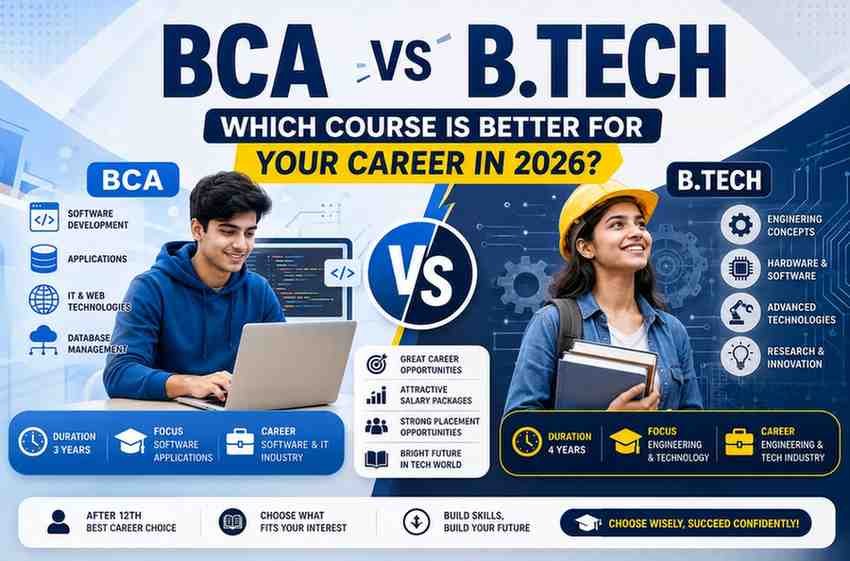
Bachelor of Computer Applications (BCA) is an undergraduate UG course comprising of a three-year program related to computer applications, software, databases, programming, networks, and web technologies.
The BCA course is different from the engineering syllabus as it focuses more on software skills and applications. The students are taught programming languages, software design, and development along with a deeper understanding of computer science and how various software systems are designed to operate in business environments.
BCA is therefore a sought-after course by students interested in venturing into the field of information technology without completing an engineering program in computer science
Students usually learn
Programming Languages
Database Management Systems
Web Development
Software Engineering
Operating Systems
Computer Networks
Mobile Application Development
Cloud Computing Basics
Many graduates continue with MCA, certifications, or industry training to specialize in emerging technologies.
What Is B.Tech?
A Bachelor of Technology (B.Tech) is an undergraduate academic degree course that lasts for four years and provides theoretical and practical knowledge of engineering and computer science.
The course covers topics such as mathematics, engineering principles, algorithms, hardware, software, and cutting-edge technologies.
Unlike the BCA, the B.Tech program covers a wide range of engineering topics that prepare students for technical, research, and development-related jobs.
A Computer Science Engineering specialization usually covers
Data Structures
Algorithms
Artificial Intelligence
Machine Learning
Operating Systems
Computer Architecture
Software Engineering
Cloud Computing
Cyber Security
Internet of Things
The engineering approach makes B.Tech suitable for students interested in solving complex technical problems.
BCA vs B.Tech Comparison
Although both courses lead to technology careers, the learning approach is quite different.
BCA vs B.Tech Eligibility
Before choosing a course, it is important to understand the admission requirements.
BCA Eligibility
Most colleges require students to complete Class 12 from a recognized board. Many universities accept students from different streams, although eligibility rules may vary.
B.Tech Eligibility
Most engineering colleges require students to complete Class 12 with Physics, Chemistry, and Mathematics. Some institutions also conduct entrance examinations or consider national-level entrance scores.
Students should always check the admission requirements of their preferred college before applying.
Course Duration
One of the noticeable differences between BCA vs B.Tech is the duration.
A BCA degree usually takes three years to complete, allowing students to enter the job market earlier.
A B.Tech degree requires four years because it includes additional engineering subjects, laboratory work, practical sessions, and project-based learning.
If your priority is starting your career sooner, BCA may be an attractive option. However, if you prefer a deeper engineering curriculum, the additional year in B.Tech can provide broader technical exposure.
Subjects You Will Study
The subjects covered in both programs also differ significantly.
BCA Subjects
Programming Languages
Database Management
Computer Networks
Software Development
Web Technologies
Mobile Applications
Information Systems
B.Tech Subjects
Engineering Mathematics
Data Structures
Computer Architecture
Artificial Intelligence
Machine Learning
Operating Systems
Software Engineering
Algorithms
Computer Networks
Students interested in software applications generally enjoy the BCA curriculum, while those interested in engineering concepts often prefer B.Tech.
Which Skills Will You Develop?
Regardless of the course you choose, employers expect graduates to have practical skills along with academic knowledge.
Skills Developed Through BCA
Programming
Web Development
Database Management
Problem Solving
Software Testing
Communication Skills
Skills Developed Through B.Tech
Engineering Design
Programming
Analytical Thinking
Technical Problem Solving
Project Management
Research Skills
The good news is that both courses help students prepare for careers in the rapidly growing IT sector.
BCA vs B.Tech Career Scope
The main reason why students get confused while comparing BCA vs B.Tech is the career scope. Students have to understand that there is no problem with the career after both degrees. The only difference between BCA vs B.Tech is the path they choose while entering into IT companies.
Students who have pursued BCA can enter into IT industries as developers, Web Developers, application support, database administration, or IT service jobs. B.Tech degree holders can also take up application support, application development, database administration, or other IT service jobs. On the flip side, BTech graduates can choose from many fields like engineering and technical areas that require engineering graduates.
Nowadays, industry requirements are varying; they do not just rely on academic credentials. So, anyone with adequate knowledge and necessary skills can enter into the IT field and can get placed in the core domain area alongside BTech holders.
Popular Career Opportunities After BCA
Software Developer
Web Developer
Mobile App Developer
Database Administrator
UI/UX Developer
System Administrator
IT Support Engineer
Software Tester
Popular Career Opportunities After B.Tech
Software Engineer
Full Stack Developer
Cloud Engineer
Cybersecurity Analyst
Data Engineer
DevOps Engineer
AI Engineer
Network Engineer
Both courses provide opportunities in startups, multinational companies, government organizations, and the freelancing market.
BCA vs B.Tech Salary
Salary is another important factor when choosing a course. While B.Tech graduates may receive higher starting packages in some organizations, salaries ultimately depend on your skills, certifications, internships, and work experience.
Average Salary Comparison
These salary ranges are approximate and vary depending on the company, location, and individual performance.
The important point is that continuous learning has a bigger impact on salary than the course itself. Many BCA graduates significantly increase their earning potential by gaining certifications, building strong portfolios, or pursuing higher studies.
Placement Opportunities
Placement opportunities depend on several factors, including the reputation of the college, your technical skills, internship experience, communication abilities, and project work.
Large IT companies recruit graduates from both BCA and B.Tech programs. During campus placements, recruiters often evaluate coding ability, logical thinking, aptitude, and problem-solving skills rather than focusing only on the degree.
To improve your placement chances:
Build real projects.
Learn programming beyond the classroom.
Complete internships.
Earn industry-recognized certifications.
Practice coding regularly.
Develop communication and teamwork skills.
Students who actively improve these areas generally perform better during placement drives.
Higher Study Options
Learning should not stop after graduation. Higher education can help you specialize and unlock better career opportunities.
After BCA
You can consider:
MCA
MBA
PG Diploma
Cloud Computing Certifications
Cybersecurity Certifications
Data Science Certifications
After B.Tech
Popular options include:
M.Tech
MBA
MS Abroad
Professional Certifications
Specialized Technology Programs
Choose higher studies based on your interests rather than following trends.
Which Course Should You Choose?
There is no single answer because every student's goals are different.
Choose BCA if you:
Enjoy programming and software development.
Want to enter the IT industry quickly.
Prefer application-based learning.
Plan to pursue MCA or professional certifications later.
Choose B.Tech if you:
Have a strong interest in engineering concepts.
Enjoy mathematics and analytical subjects.
Want broader technical exposure.
Plan to pursue engineering or research careers.
The most successful professionals are those who continue learning after graduation. Your degree opens the first door, but your skills determine how far you progress.
Expert Advice
Many students spend weeks debating BCA vs B.Tech. While the comparison is important, remember that employers rarely hire someone based only on their degree.
They look for candidates who can solve problems, build projects, communicate effectively, and adapt to new technologies.
If you remain curious, practice consistently, and build practical experience through internships and projects, both BCA and B.Tech can lead to excellent careers.
Conclusion
Deciding between the BCA vs B Tech is not a matter of which one is better but rather which one suits you the best. The reason is simple: if you have an interest in software development and want to get into the IT field faster, then you should go with BCA, whereas if you have an interest in engineering and want broader opportunities in your career, then you should choose B Tech.
Before taking your final decision, do proper research on the colleges, the syllabus, placements, and future prospects of both courses. You can even contact us for admission assistance via our Contact Us page, or you can also check out our About Us page to know more about how Tulyarth EduTech can help you in your educational pursuits.
Frequently Asked Questions
Neither course is universally better. BCA is ideal for students interested in software applications and IT, while B. Tech suits those who want an engineering-focused education. The right choice depends on your interests and career goals.
Yes. With strong technical skills, certifications, internships, and experience, many BCA graduates achieve salaries comparable to B.Tech professionals.
Both BCA and B.Tech offer good placement opportunities. Your coding skills, projects, internships, and communication abilities play a major role in securing a job.
BCA generally focuses more on software applications and has a shorter duration, while B. Tech includes additional engineering concepts and advanced mathematics. The level of difficulty depends on your interests and strengths.
Choose BCA if you want to build a career in software development through application-based learning. Choose B.Tech if you prefer engineering, technical research, and a broader computer science curriculum.