
B.Sc Course in Dehradun: Eligibility, Fees, Duration & Career Scope in 2026
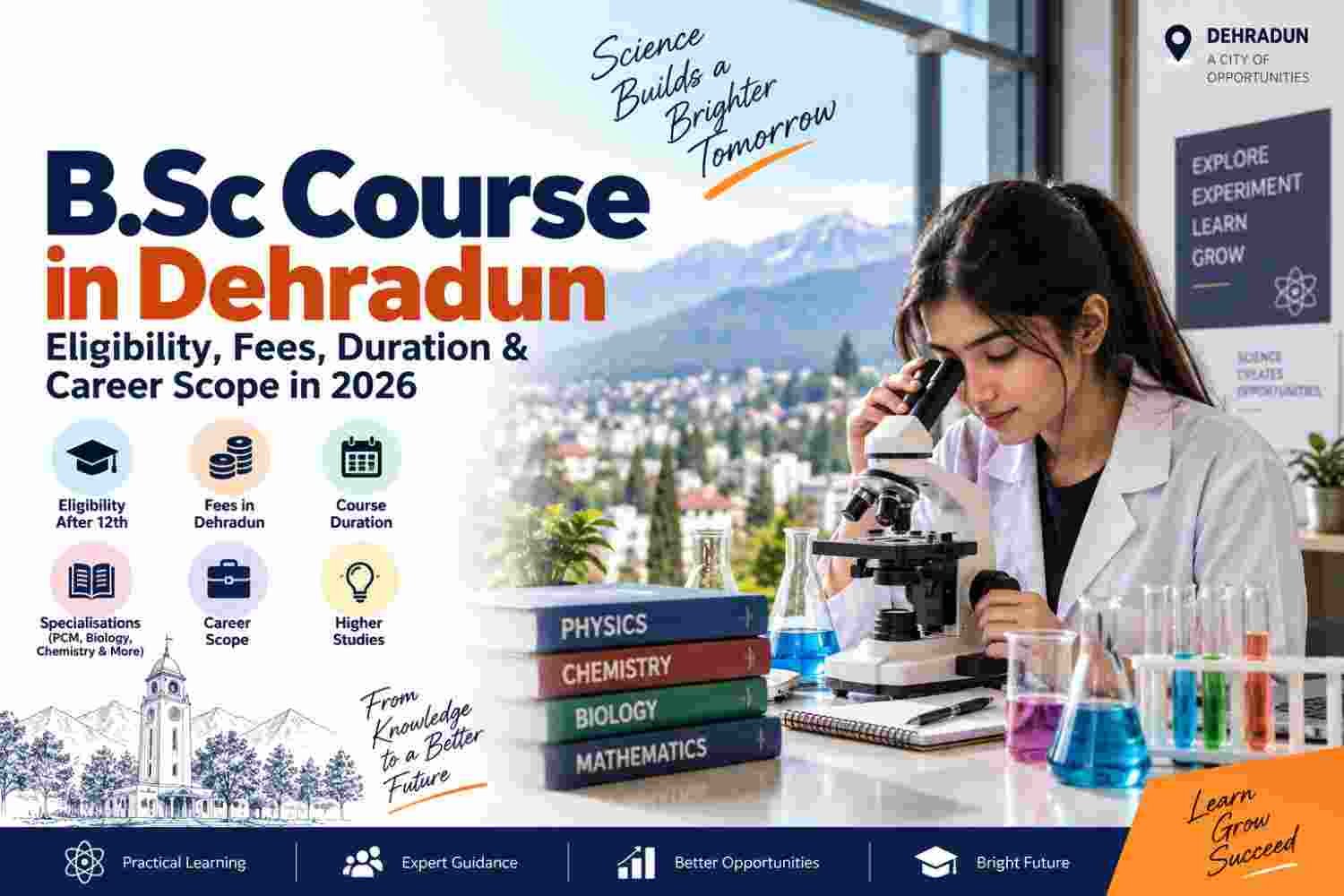
19
Sep
B.Sc Course in Dehradun: Eligibility, Fees, Duration & Career Scope in 2026
Published: September 19, 2026
Last Updated: September 19, 2026
Bottom Line
A B.Sc Course in Dehradun is an undergraduate study option for students who want to build a foundation in science and explore higher studies, research, teaching, technical fields, or other science-related careers. However, the subjects, eligibility, duration, admission process, and fees can differ depending on the university and B.Sc specialisation.
Tulyarth EduTech currently lists several B.Sc options in Dehradun, including PCM, Mathematics, Physics, Chemistry, Biology and Home Science. Its listed B.Sc programmes are shown as 3-year, offline degree programmes associated with GRD University, Dehradun.
Quick Answer: B.Sc Course in Dehradun
A B.Sc, or Bachelor of Science, is an undergraduate degree for students interested in subjects such as Mathematics, Physics, Chemistry, Biology, and other science disciplines.
In Dehradun, students can find different B.Sc specialisations rather than one single B.Sc structure. Therefore, before admission, compare the specialisation, eligibility, duration, syllabus, practical learning, university, fees, and future study options.
For example, Tulyarth EduTech currently lists B.Sc PCM, Mathematics, Physics, Chemistry, Biology, and Home Science programmes in Dehradun.
Key Takeaways
B.Sc stands for Bachelor of Science.
B.Sc is an undergraduate degree with different subject combinations and specialisations.
Tulyarth currently lists multiple B.Sc options in Dehradun.
Several listed Tulyarth B.Sc programmes have a 3-year duration.
Eligibility depends on the university and selected specialisation.
Fees can vary significantly, so students should confirm the current fee before admission.
B.Sc. can lead to higher studies such as M.Sc. and other academic or professional pathways.
Practical subjects can include laboratory work, experiments, projects, and scientific analysis.
What Is a B.Sc. Course?
B.Sc. stands for Bachelor of Science. It is an undergraduate programme designed to develop subject knowledge, analytical thinking, problem-solving ability, and practical understanding in a chosen science discipline.
The exact curriculum depends on the specialisation. For instance, a B.Sc Physics programme can focus on mechanics, thermodynamics, optics and modern physics, while B.Sc Mathematics can cover areas such as algebra, calculus, statistics and differential equations.
Similarly, B.Sc Chemistry can include organic, inorganic and physical chemistry along with laboratory work. B.Sc Biology can cover areas such as genetics, microbiology, botany, zoology and ecology.
Who Should Consider a B.Sc Course in Dehradun?
A B.Sc. course in Dehradun can be considered by:
Students who have completed Class 12 and want to continue in science.
Students interested in Physics, Chemistry, Mathematics, or Biology.
Learners planning to pursue M.Sc. or further academic study.
Students interested in research-oriented careers.
Students preparing for competitive examinations alongside graduation.
Learners who want a science-based undergraduate foundation before choosing a specialised career path.
However, eligibility should always be checked against the specific university and programme because subject requirements can differ.
B.Sc Eligibility After 12th
Generally, B.Sc admission is intended for students who have completed 10+2 or an equivalent qualification, but the required subjects and minimum marks can vary according to the programme and institution.
For example, a B.Sc programme based on Physics, Chemistry and Mathematics may require a relevant science background, while a Biology-focused programme can have different subject requirements.
Therefore, students should check:
Important: There is no single eligibility rule that applies to every B.Sc programme in India. Always verify the current admission requirements before applying.
B.Sc Course Duration
The duration of a B.Sc programme depends on the university and programme structure.
Tulyarth EduTech currently lists several B.Sc programmes in Dehradun as 3-year undergraduate degree programmes. The listed programmes include PCM, Mathematics, Physics, Chemistry, Biology and Home Science.
At the broader policy level, India's National Education Policy provides for undergraduate programmes of three or four years with multiple exit options, while the exact structure depends on the institution and programme.
B.Sc Specialisations in Dehradun
One of the biggest advantages of choosing B.Sc is the range of subjects available.
The actual subjects and semester structure can vary by university, so students should review the current syllabus before admission.
B.Sc Course Fees in Dehradun
There is no single fixed B.Sc course fee in Dehradun because fees depend on the university, specialisation, facilities, admission structure, and other factors.
Tulyarth's current B.Sc listings display different fee-related information in their descriptions, while the course interface also shows a ₹0 placeholder total fee. Because of this inconsistency, an exact fee should not be assumed from the website listing and should be confirmed with the institution before admission.
Before paying any admission amount, ask for the latest details regarding:
Tuition fee
Examination fee
Laboratory charges
University charges
Registration or admission charges
Any additional semester expenses
What Will You Study in B.Sc.?
Your subjects will depend on your chosen specialisation. However, B.Sc. education generally combines theoretical concepts with practical learning.
For example, science-based programmes may include:
Core science subjects
Laboratory experiments
Mathematical and analytical concepts
Scientific problem-solving
Practical assignments
Projects and presentations
Research-oriented learning
For instance, Tulyarth's B.Sc Physics listing highlights experiments and scientific reasoning, while the Chemistry listing includes laboratory techniques and chemical analysis.
Admission Process for B.Sc in Dehradun
The admission process can vary between universities. A typical process may include:
Step 1: Select your B.Sc specialisation.
Step 2: Check the university's eligibility requirements.
Step 3: Compare the syllabus, duration, and fees.
Step 4: Submit the required application and documents.
Step 5: Complete the university's admission or selection process.
Step 6: Confirm the fee structure before enrollment.
If you are comparing options, Tulyarth EduTech can provide course and admission guidance through its platform. About Us
B.Sc vs BCA: Which One Should You Choose?
B.Sc and BCA can lead to very different academic directions.
Therefore, students should choose according to their interests, Class 12 subjects, and long-term career plans, rather than selecting a course only because it appears popular.
Career Scope After B.Sc
Career options after B.Sc depend heavily on the specialisation, skills, experience, and further qualifications.
Possible pathways include:
Research-related roles
Laboratory and technical work
Education and teaching after required qualifications
Data and analytical fields
Pharmaceutical and chemical sectors for relevant science backgrounds
Environmental and life-science fields
Government and competitive examinations
Higher education and research
For many students, a B.Sc is also the beginning of further education rather than the final qualification. An M.Sc, professional certification, B.Ed, or another relevant postgraduate programme can expand the available career pathways depending on the student's subject and goals.
Higher Studies After B.Sc
After completing B.Sc, students can consider different options based on their specialisation.
Common choices include:
M.Sc: Suitable for students who want deeper knowledge in their science discipline.
B.Ed: Can be considered by students planning a teaching pathway, subject to applicable eligibility requirements.
MBA: Can be considered by graduates interested in management and business-related careers.
Competitive Examinations: Graduates can also explore government and other competitive examinations according to the relevant eligibility rules.
Research: Students interested in scientific research can continue towards postgraduate and research-oriented programmes.
How to Choose a B.Sc College in Dehradun
Before selecting a B.Sc programme, don't compare colleges only on the basis of fees.
Instead, check:
University affiliation and recognition
B.Sc specialisation available
Eligibility requirements
Complete syllabus
Laboratory facilities
Practical learning opportunities
Faculty and academic support
Course duration
Total fee structure
Higher-study and career pathways
Additionally, ask for the latest fee and admission information in writing before making a payment.
Why Consider B.Sc in Dehradun?
Dehradun has a strong education ecosystem and offers students access to different academic streams. For a student interested in science, the city provides options across areas such as Physics, Chemistry, Mathematics, Biology, and related disciplines.
Tulyarth EduTech currently lists multiple B.Sc programmes in Dehradun and provides course information and admission guidance for students exploring undergraduate options.
For course availability, current admission details, or guidance, you can Contact Us.
Is B.Sc a Good Choice After 12th?
B.Sc can be a relevant option for students who genuinely want to study science at the undergraduate level. The right choice depends on the student's preferred subjects, academic background, and future plans.
For example, a student interested in Physics may choose B.Sc Physics, while another interested in Mathematics may prefer B.Sc Mathematics. Similarly, students interested in life sciences can explore Biology-related programmes.
The important point is to choose the specialisation first and then evaluate the university, syllabus, practical exposure, fees, and future opportunities.
Latest Blogs
You may also find these articles helpful:
BFA Course in Dehradun: Eligibility, Fees, Duration & Career Scope in 2026
B.Arch Course in Dehradun: Eligibility, Fees, Duration & Career Scope in 2026
B.Pharm Course in Dehradun: Eligibility, Fees, Duration & Career Scope in 2026
B.Ed Course in Dehradun: Eligibility, Fees, Duration & Career Scope in 2026
B.Des Course in Dehradun: Eligibility, Fees, Duration & Career Scope in 2026
Frequently Asked Questions
A B.Sc. course in Dehradun is an undergraduate Bachelor of Science programme offered through different science specialisations. The exact subjects, eligibility, and duration depend on the university and programme.
Many B.Sc programmes are structured as three-year undergraduate degrees. Tulyarth EduTech currently lists several B.Sc programmes in Dehradun with a 3-year duration.
Eligibility depends on the selected B.Sc specialisation and university. Generally, students need to complete Class 12 or an equivalent qualification, with required science subjects where applicable.
Career options depend on the B.Sc. specialisation. Students can explore employment, competitive examinations, teaching after required qualifications, technical or laboratory roles, or higher studies such as M.Sc.
Yes, students can generally pursue M.Sc. in a relevant discipline after B.Sc., subject to the eligibility requirements of the university and specific postgraduate programme.